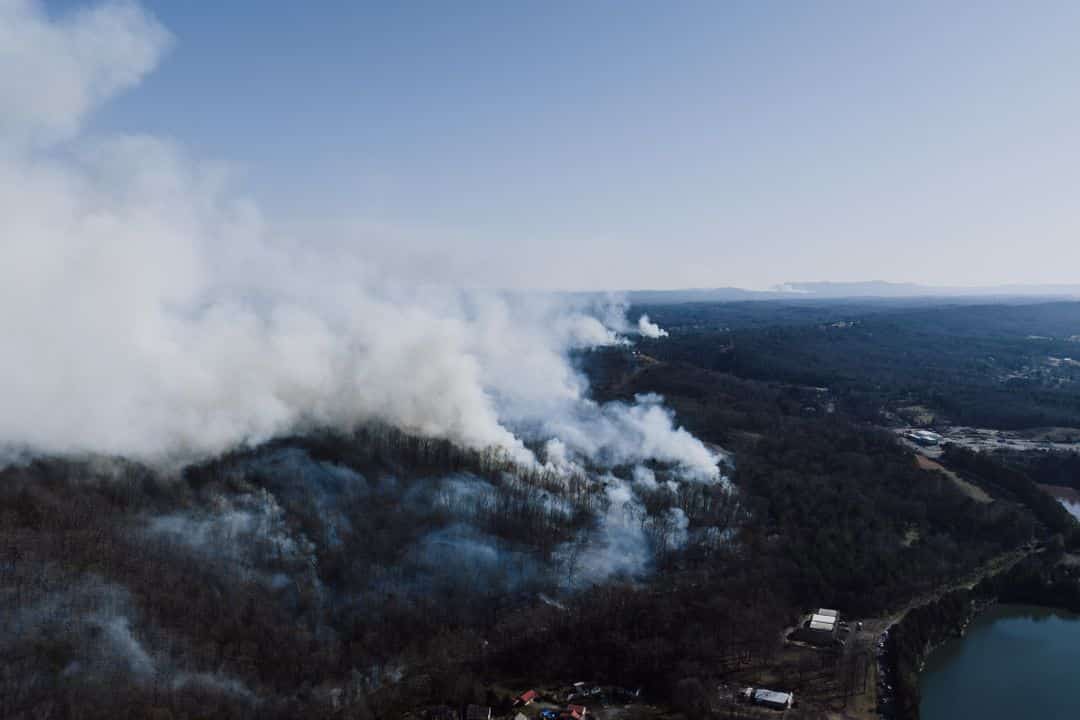
When a wildfire breaks out, most people assume the impact is limited to nearby communities. However, recent wildfire seasons have shown that smoke can travel thousands of miles, affecting air quality in regions far removed from the actual fires. In recent years, smoke from Canadian wildfires has reached major cities across North America, while smoke from fires in other parts of the world has crossed entire countries and even oceans.
This phenomenon has raised an important question: how can wildfire smoke travel such incredible distances? The answer lies in atmospheric science, wind patterns, and the tiny particles that make up wildfire smoke. Understanding this process helps explain why communities far from active fires can still experience poor AQI levels and elevated PM2.5 concentrations.
What Is Wildfire Smoke Made Of?
Wildfire smoke is a complex mixture of gases and particulate matter released when vegetation, trees, and other organic materials burn. Among the many pollutants present in smoke, PM2.5 is considered the most significant from an air quality and health perspective.
Wildfire smoke typically contains:
- PM2.5
- PM10
- Carbon monoxide
- Nitrogen oxides
- Volatile organic compounds (VOCs)
- Various chemical byproducts of combustion
Because PM2.5 particles are extremely small, they can remain suspended in the atmosphere for extended periods. This characteristic plays a major role in allowing smoke to travel long distances.
Why Smoke Doesn’t Stay Near the Fire
Many forms of pollution, such as vehicle emissions or industrial pollution, remain relatively concentrated near their source. Wildfire smoke behaves differently because fires generate enormous amounts of heat.
As vegetation burns, hot air rises rapidly and carries smoke high into the atmosphere. In large wildfire events, smoke can reach several kilometers above the Earth’s surface. Once smoke enters higher atmospheric layers, it becomes influenced by regional and global wind patterns rather than local weather conditions.
This process effectively transforms wildfire smoke into a long-range air pollution source capable of affecting areas far beyond the fire zone.
The Role of Wind Patterns
Wind is one of the most important factors controlling how far wildfire smoke travels. Strong upper-level winds can transport smoke across provinces, states, and international borders within a matter of days.
Meteorologists often track smoke movement using satellite imagery and atmospheric models. These tools frequently show smoke plumes stretching across thousands of miles. Depending on weather conditions, smoke may remain elevated in the atmosphere or gradually descend closer to the ground, where it can affect local AQI readings.
This explains why cities located hundreds or even thousands of miles from active wildfires may suddenly experience hazy skies and poor air quality.
How PM2.5 Enables Long-Distance Travel
The size of pollution particles plays a critical role in determining how far they can travel. Larger particles tend to settle relatively quickly due to gravity. PM2.5 particles, however, are so small and lightweight that they can remain airborne for days or even weeks.
Because of their tiny size, PM2.5 particles can be carried long distances by atmospheric currents before eventually settling or being removed by rainfall. During major wildfire events, these particles often become the primary reason AQI levels increase in regions far from the original fires.
This is why air quality alerts may be issued in locations that have no local wildfire activity.
How Weather Influences Smoke Movement
Several weather conditions affect the movement and concentration of wildfire smoke.
Strong Winds
Higher wind speeds can transport smoke more quickly and over greater distances. Large-scale weather systems often determine the direction and speed of smoke movement.
Atmospheric Stability
Stable atmospheric conditions can trap smoke within specific layers of the atmosphere, allowing it to travel farther before dispersing.
Rainfall
Rain acts as a natural air-cleaning mechanism by removing smoke particles from the atmosphere. Areas receiving rainfall often experience rapid improvements in AQI levels after smoke events.
Temperature Inversions
Temperature inversions can prevent smoke from dispersing vertically, allowing pollutants to accumulate closer to the ground and worsen local air quality.
Why Distant Cities Experience Poor Air Quality
One of the most surprising aspects of wildfire smoke is that communities far from active fires can sometimes experience worse air quality than areas located closer to the fire itself.
This occurs because changing weather conditions can concentrate smoke in specific regions. As smoke plumes move across large distances, they may descend toward the surface and become trapped by local atmospheric conditions. When this happens, AQI levels can increase rapidly, even though no nearby fire exists.
Recent wildfire seasons have demonstrated how interconnected air quality can be across large geographic areas. A major fire event in one region can influence pollution levels across an entire continent.
Health Effects of Long-Distance Smoke Pollution
Even after traveling hundreds or thousands of miles, wildfire smoke can still contain significant concentrations of harmful pollutants. Exposure to elevated PM2.5 levels can affect both healthy individuals and vulnerable populations.
Common health effects include:
- Coughing
- Eye irritation
- Throat irritation
- Headaches
- Shortness of breath
- Worsening asthma symptoms
Children, older adults, pregnant women, and individuals with respiratory or cardiovascular conditions are often at greater risk during smoke events.
How to Protect Yourself During Smoke Events
When long-distance wildfire smoke affects your region, monitoring AQI levels becomes especially important.
Consider these precautions:
- Check AQI forecasts regularly.
- Reduce outdoor activities during unhealthy air quality periods.
- Keep windows and doors closed when smoke levels are high.
- Use HEPA air purifiers if available.
- Wear an N95 mask during severe smoke events.
- Pay special attention to vulnerable family members.
Taking these steps can help reduce exposure to harmful pollutants during periods of poor air quality.
Conclusion
Wildfire smoke can travel thousands of miles because of a combination of intense heat, atmospheric circulation, wind patterns, and the extremely small size of PM2.5 particles. Once smoke rises into higher layers of the atmosphere, it can be carried across vast distances and affect AQI levels far from the original fire source.
As wildfire seasons become more intense, understanding the science behind long-distance air pollution is becoming increasingly important. By monitoring air quality forecasts and staying informed about smoke events, individuals can take practical steps to protect their health even when the nearest wildfire is hundreds of miles away.